How an Ordinary Piece of Paper Becomes History

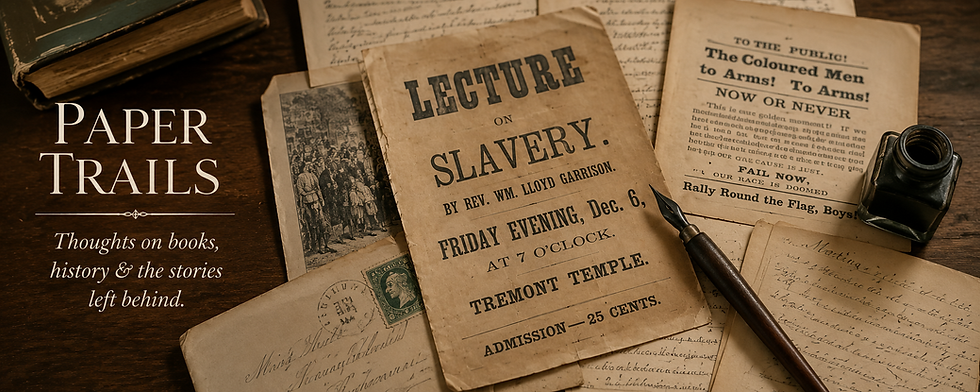
Most people do not expect history to look flimsy. History, in our collective imagination, arrives leather-bound. Heavy. Respectable. It smells faintly of dust and seriousness. Ideally, it lives behind glass somewhere with a curator standing nearby to remind you not to breathe too aggressively.
But some of the most revealing historical artifacts I encounter as a rare book dealer begin life as paper no one intended to save.
A protest flyer. A church handbill. A folded program. A grocery list tucked into a cookbook. A mimeographed newsletter that somehow survived three moves, two floods, and someone’s brief but catastrophic “minimalist phase.”
The ordinary paper of everyday life has a habit of becoming extraordinary simply by surviving. This surprises people.
At book fairs or archive appointments, I am often handed a small stack of seemingly unremarkable material with an apologetic disclaimer:
“It’s probably nothing.”
Reader, it is very rarely nothing.
Sometimes it is a labor union flyer from a local strike no historian documented in detail. Sometimes it is a family scrapbook preserving neighborhood businesses that no longer exist. Sometimes it is a small-town women’s club newsletter revealing who held power in a community, what people feared, what they celebrated, and what they quietly ignored.
The magic of ephemera - and yes, rare booksellers use that wonderfully dramatic word - is that it was never meant to last. The term comes from the Greek ephemeros, meaning “lasting only a day.”
These are the materials designed for immediate use rather than preservation: tickets, posters, menus, pamphlets, circulars, flyers, postcards, broadsides, and newsletters. They announce events, spread ideas, settle arguments, advertise products, organize communities, or simply tell people where to show up on Thursday at seven o’clock.
Then, ideally, they disappear.
And most of them did.
That is exactly what makes surviving examples so valuable.
Imagine trying to understand a city using only official records. You might know when laws passed, who held office, or what institutions decided. But you would miss the texture of ordinary life. You would not know what people pinned to church doors, passed hand to hand, argued over at kitchen tables, or slipped into coat pockets on the way home.
You would miss what people were actually paying attention to.
A single surviving flyer can tell us astonishing things.
A torn lecture notice might reveal a social movement reaching a small town. A penciled annotation in the margin of a pamphlet may preserve someone arguing back across time. A faded broadside with tack holes still visible tells us it once hung in public, competing for attention against advertisements, politics, and daily distraction.
Even damage matters.
A crease says someone folded it.
Smoke stains suggest proximity to fire.
Paste residue means it once hung somewhere important enough to post publicly.
Tack holes quietly announce:
Someone wanted this seen.
One of the strangest parts of my job is watching the hierarchy of importance collapse. A beautifully bound nineteenth-century book? Wonderful.
But the folded church bulletin accidentally tucked inside it for 130 years? Sometimes even better. Because history often survives sideways.
Not in the grand objects people carefully protected, but in the scraps that escaped being thrown away.
So the next time you open an old book and find a receipt, postcard, pressed flower, meeting notice, or handwritten note, pause before tossing it aside.
You may be holding the part of history no one expected to survive.
And those are often the best stories.
What is the strangest piece of paper you have ever found tucked inside a book or box? I would love to hear about it in the comments.

Comments